Thursday, August 27, 2009

Neither should reality tv, but...


The journal, Nature, is reporting that the Wide Area Search for Planets (WASP, of course) has found a planet that shouldn't exist, given everything we (and when I say "we" I mean "People who are way smarter than I am") know. The planet was discovered by -- and the Nature article written by -- a team headed by astrophysicist Coel Hellier of Keene University.

WASP-18b is about 325 light-years away. It's huge -- 10 times the mass of Jupiter, but what's crazy is that it apparently is just 1.4 million miles (a walk to the mailbox in astronomical terms) from its star. Its orbit is less than one Earth day. Sky and Telescope says its surface temperature is a balmy 3,800°F

The article points out that tidal interactions should have stretched the star and slowed the planet to the point where they smashed into each other a long time ago. The planet is very near the "Roche Limit," which is the point at which its star's gravity will start to tear it apart.

Astrophysicists are watching WASP-18b, either to see its death throes or figure out why they aren't happening.

Favorite part of the story: "The 750-word article is making some big waves in the extra-solar planet community." I don't know why I find that hilarious.

Tuesday, August 18, 2009

It was cloudy oudy oudy oudy oudy out

I was so excited. I was going to be at Grayton Beach during the Perse ersi ersi ids. (Check out the Lou and Peter Berryman song; it's great). Every night was beautiful; Venus was bright, and Scorpio was outstanding on the beach side of the house; Ursa Major and Casseopeia on the lake side. I had told all the other folks staying with us that I would wake them up to see the meteor shower. So I planned on doing that for the folks that actually were interested. Unfortunately, the sky was cloudy. We were at the beach for seven days and nights. The sky was clear for six of those seven nights. The only night it wasn't clear was August 12. I woke up at 3 am, 4 am, 5 am and 6 am, and saw NOTHING. NADA.

Next night, nothing. Next night, four shooting stars. Which was great because one kid who was with us at the beach, and is usually the kid who is hardest to take, was all over my knowledge of the stars and loved my laser pointer. This kid, just 8 years old, kept asking me to go outside with her to show her the stars. She had never seen a shooting star, until one night when we saw four. She is not the kid I would have ever thought would be interested in this stuff, but she was. I am so taking her to the planetarium this Thursday.

She is my new favorite kid. She was so happy to see her first shooting star, even though it was not a Perseid, given where it occurred in the sky.

But her parents, and the parents of other kids with us at the beach, all said that I was their new natural history guide. Because I know a lot about birds and stars. I figure that's a good way to be known.

But still, I am really disappointed that I was in a spot where the Perseids would be clear and I freaking couldn't see them.

Wednesday, August 5, 2009

Good Perseids coming!

From Spaceweather.com comes this info:


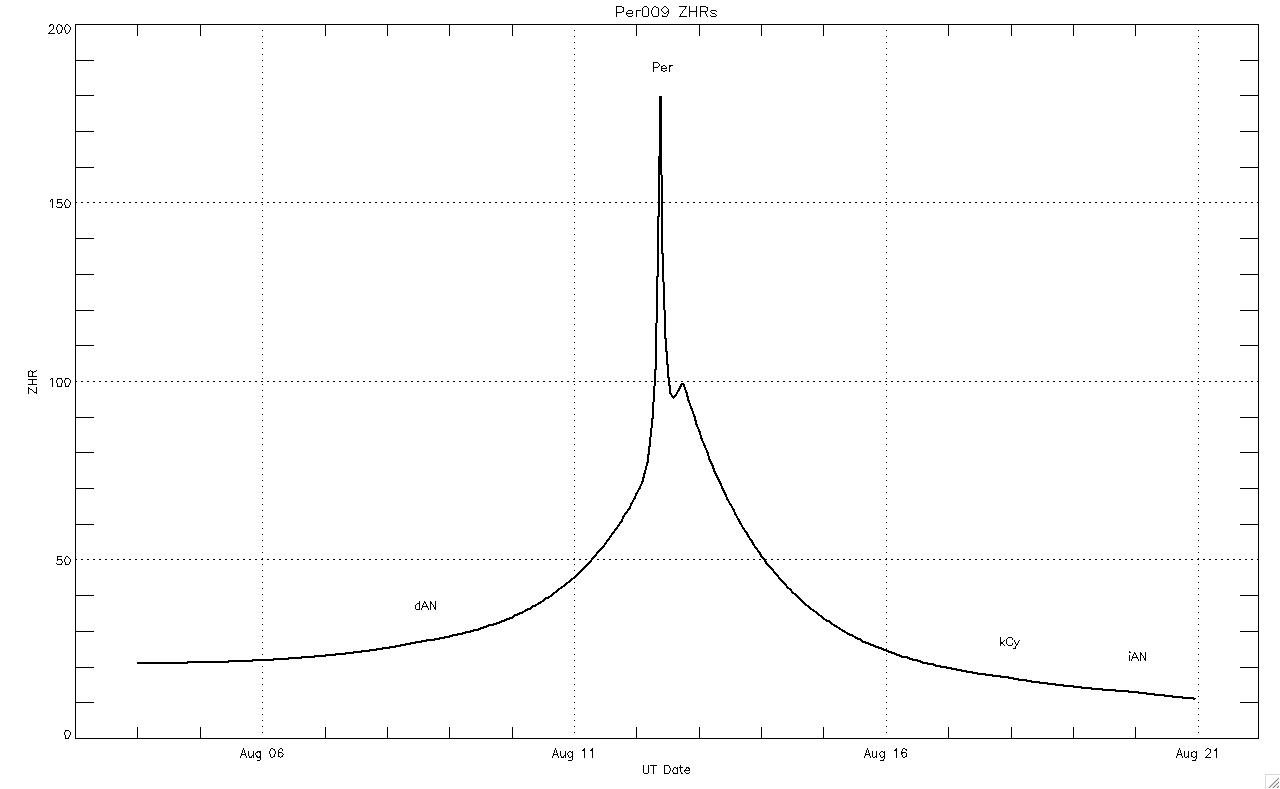
POSSIBLE PERSEID OUTBURST: This year's Perseid meteor shower could be even better than usual. "A filament of comet dust has drifted across Earth's path and when Earth passes through it, sometime between 0800 and 0900 UT (1 - 2 am PDT) on August 12th, the Perseid meteor rate could surge to twice its normal value," says Bill Cooke of NASA's Meteoroid Environment Office. The following profile is based on the debris stream models of veteran forecasters Jeremie Vaubaillon and Mikhail Maslov:

The filament was shed by Perseid parent comet Swift-Tuttle in the year 1610, and this is one of Earth's first encounters with it. "In addition," notes Cooke, "the main Perseid debris stream, which we run into every year, may be denser than normal due to a gravitational enhancement by Saturn. The total combination of these effects could result in as many as 200 meteors per hour (ZHR)."

Bright moonlight will overwhelm the outburst's fainter Perseids, but even a fraction of 200 is a good show. Science@NASA's "The Perseids are Coming" offers observing tips and sky maps.


We're heading up to Wheaton with the Adler folks. Here's the info on that:

Meteor Shower Star Party
Wednesday, August 12, 2009
7:30 p.m. - 11:00 p.m.
Cantigny Park, Wheaton, IL
Join the Adler Planetarium as we celebrate the annual Perseid Meteor Shower! Watch shooting stars cascade across the sky while relaxing with your family in beautiful Cantigny Park.
The evening will include:
  • Excerpts from One World, One Sky: Big Birds Adventure, in the Adler's portable planetarium dome
  • Hands-on educational activities for families
  • Telescope viewing
  • Science presentation on the Hubble Space Telescope
  • Time for picnicking, stargazing, and family fun!
  • Tickets are $5 for Adler members, $10 for non-members


Saturday, August 1, 2009

Nothing like Wyoming skies...

You can click to enlarge any of these photos; however, I'm ordering you to click and enlarge this one.


The Milky Way Over Devils Tower


Credit & Copyright: Wally Pacholka (TWAN)

Explanation: Was Devils Tower once an explosive volcano? Famous for its appearance in films such as Close Encounters, the origin of Devil's Tower in Wyoming, USA is still debated, with a leading hypothesis holding that it is a hardened lava plume that probably never reached the surface to become a volcano. The lighter rock that once surrounded the dense volcanic neck has now eroded away, leaving the dramatic tower. High above, the central band of the Milky Way galaxy arches across the sky. Many notable sky objects are visible, including dark strands of the Pipe Nebula and the reddish Lagoon Nebula to the tower's right. Green grass and trees line the moonlit foreground, while clouds appear near the horizon to the tower's left. Unlike many other international landmarks, mountaineers are permitted to climb Devils Tower.

WFPC3 earns its keep.

New shot of the July 19th Jupiter impact.


SN 1006


Became visible in the year 1006.
(Actually exploded 7,000 years prior.)
Debris cloud is 60 ly across.

Image Credit: NASA, ESA, Zolt Levay (STScI)

Eagle Nebula

Photo Credit: Emanuele Colognato

Sky this week.

This date in history.


1950 - Patrick AFB is named after General Mason Patrick

1985 - Buran Cosmonaut Group 2 selected. Things wouldn't work out well for the test pilots or the Buran program, as a general rule.

And finally, happy birthday and a big welcome home to Koichi Wakata.

Top 5 objects you can see with a small telescope.

Nancy at UT has a nice little article on the top five astronomical objects which can be seen with a small telescope. It's a good little list. Of course, the comments section is equally entertaining, with people sniping about why M such-and-such was left out and how they can't see all those things with their telescope, etc.


Disclaimer: If you look at the Orion Nebula through your telescope (or any telescope, for that matter), it ain't gonna look like this, so please don't call Meade to complain.