Wednesday, September 9, 2009

Pretty Pictures


The mission of Atlantis, the shuttle that launched last May to make the final adjustments to the Hubble, is already paying dividends. The shuttle's astronauts installed the Wide Field Camera 3 (WFC3), which snapped this photo of the "Bug" or "Butterfly" planetary nebula.

According to NASA, the star at the center of the nebula first evolved into a huge red-giant star, with a diameter of about 1,000 times that of our Sun. It then lost its extended outer layers. Some of this gas was cast off from its equator at a relatively slow speed, perhaps as low as 20,000 miles an hour, creating the doughnut-shaped ring. Other gas was ejected perpendicular to the ring at higher speeds, producing the elongated "wings" of the butterfly-shaped structure.

Check out the description of this photo and see others at NASA's website.

Thursday, September 3, 2009

Mt. Wilson Observatory Threatened by Wildfire


Firefighters waged a five-day battle to save the Mt. Wilson Observatory from the wildfires raging in the Angeles National Forest. The Mt. Wilson Observatory is important, well, because it's a freakin' observatory. But also because it is where Edwin Hubble discovered that the universe was expanding. To lose that facility would not just be tragic from a scientific standpoint, but from a historical one, as well. And, given the fact that it hosts a wealth of emergency, cellular and television communications towers, well, I mean, LA without television? Could anything possibly be sadder?

From the LA Times:

Mt. Wilson Observatory, site of some of the greatest astronomical discoveries of the 20th century, appears to have escaped serious damage from the Station fire, but scientists working on the mountain say the blaze still managed to take a toll on the ongoing research there.

Hal McAlister, observatory director and head of the CHARA experiment that uses six telescopes to measure shapes and sizes of stars, said he was on his way to teach on Monday at Georgia State University, where he is an astronomy professor, when he heard that firefighters had pulled out and ordered his staff to leave. He was so worried he was unable to teach his class.

"I've been teaching 32 years, and I'd never lost it like that," he said.

As many as 40 different projects were under way, he added, and some people had waited a year to get observing time. They will have to be rescheduled, but McAlister was philosophical about that: "Losing observing time is a small problem compared to losing the observatory," he said.

Charles Townes, a Nobel-Prize-winning astrophysicist at UC Berkeley who recently discovered that the bright star Betelgeuse is mysteriously shrinking, said his team had been using three telescopes on mobile trailers to watch changes in the star CIT 6 when the word to evacuate came down.

The mirrors were just coated with a new aluminum reflecting surface in July. If that was damaged, the observatory might need to do the expensive process all over again.


Tragically, two firefighters died in the blaze, but, right now, it looks as if the observatory has been spared. It will be some time before it is known just how much damage it may have sustained.

Thursday, August 27, 2009

Neither should reality tv, but...


The journal, Nature, is reporting that the Wide Area Search for Planets (WASP, of course) has found a planet that shouldn't exist, given everything we (and when I say "we" I mean "People who are way smarter than I am") know. The planet was discovered by -- and the Nature article written by -- a team headed by astrophysicist Coel Hellier of Keene University.

WASP-18b is about 325 light-years away. It's huge -- 10 times the mass of Jupiter, but what's crazy is that it apparently is just 1.4 million miles (a walk to the mailbox in astronomical terms) from its star. Its orbit is less than one Earth day. Sky and Telescope says its surface temperature is a balmy 3,800°F

The article points out that tidal interactions should have stretched the star and slowed the planet to the point where they smashed into each other a long time ago. The planet is very near the "Roche Limit," which is the point at which its star's gravity will start to tear it apart.

Astrophysicists are watching WASP-18b, either to see its death throes or figure out why they aren't happening.

Favorite part of the story: "The 750-word article is making some big waves in the extra-solar planet community." I don't know why I find that hilarious.

Tuesday, August 18, 2009

It was cloudy oudy oudy oudy oudy out

I was so excited. I was going to be at Grayton Beach during the Perse ersi ersi ids. (Check out the Lou and Peter Berryman song; it's great). Every night was beautiful; Venus was bright, and Scorpio was outstanding on the beach side of the house; Ursa Major and Casseopeia on the lake side. I had told all the other folks staying with us that I would wake them up to see the meteor shower. So I planned on doing that for the folks that actually were interested. Unfortunately, the sky was cloudy. We were at the beach for seven days and nights. The sky was clear for six of those seven nights. The only night it wasn't clear was August 12. I woke up at 3 am, 4 am, 5 am and 6 am, and saw NOTHING. NADA.

Next night, nothing. Next night, four shooting stars. Which was great because one kid who was with us at the beach, and is usually the kid who is hardest to take, was all over my knowledge of the stars and loved my laser pointer. This kid, just 8 years old, kept asking me to go outside with her to show her the stars. She had never seen a shooting star, until one night when we saw four. She is not the kid I would have ever thought would be interested in this stuff, but she was. I am so taking her to the planetarium this Thursday.

She is my new favorite kid. She was so happy to see her first shooting star, even though it was not a Perseid, given where it occurred in the sky.

But her parents, and the parents of other kids with us at the beach, all said that I was their new natural history guide. Because I know a lot about birds and stars. I figure that's a good way to be known.

But still, I am really disappointed that I was in a spot where the Perseids would be clear and I freaking couldn't see them.

Wednesday, August 5, 2009

Good Perseids coming!

From Spaceweather.com comes this info:


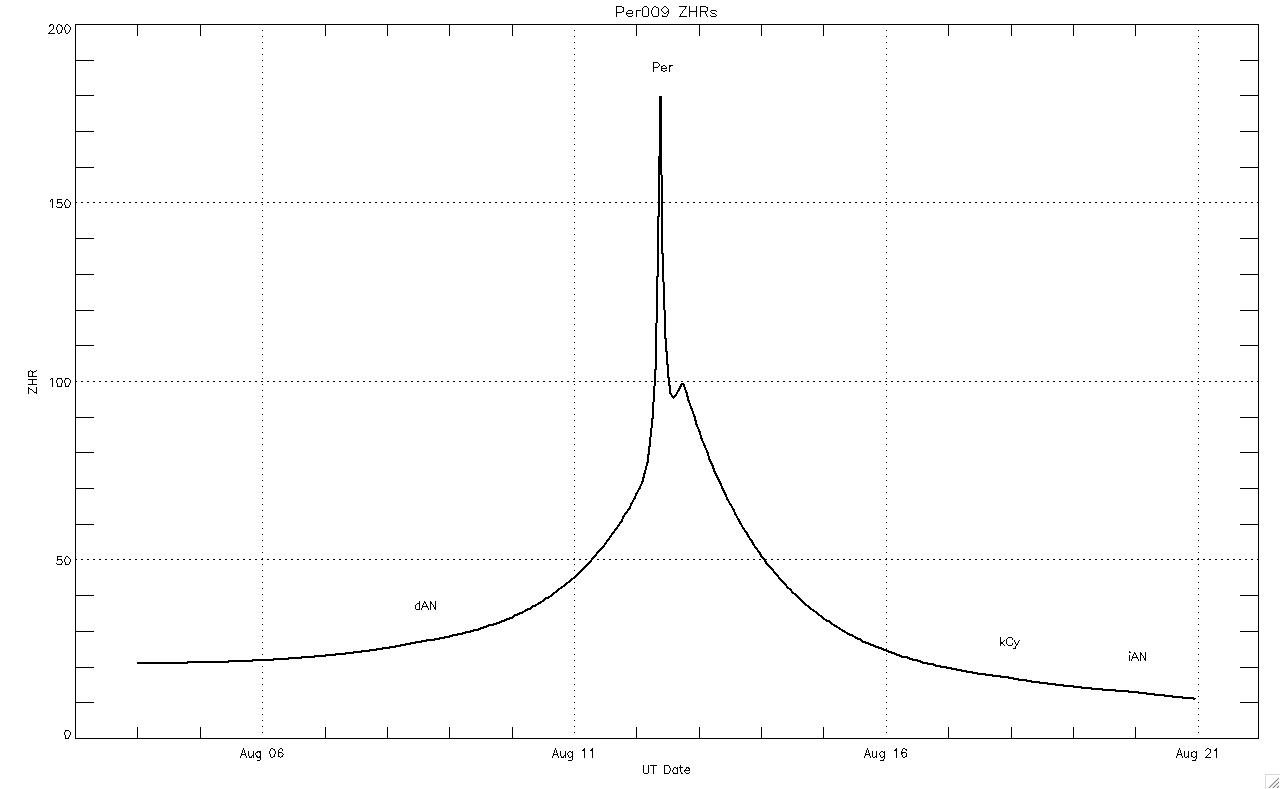
POSSIBLE PERSEID OUTBURST: This year's Perseid meteor shower could be even better than usual. "A filament of comet dust has drifted across Earth's path and when Earth passes through it, sometime between 0800 and 0900 UT (1 - 2 am PDT) on August 12th, the Perseid meteor rate could surge to twice its normal value," says Bill Cooke of NASA's Meteoroid Environment Office. The following profile is based on the debris stream models of veteran forecasters Jeremie Vaubaillon and Mikhail Maslov:

The filament was shed by Perseid parent comet Swift-Tuttle in the year 1610, and this is one of Earth's first encounters with it. "In addition," notes Cooke, "the main Perseid debris stream, which we run into every year, may be denser than normal due to a gravitational enhancement by Saturn. The total combination of these effects could result in as many as 200 meteors per hour (ZHR)."

Bright moonlight will overwhelm the outburst's fainter Perseids, but even a fraction of 200 is a good show. Science@NASA's "The Perseids are Coming" offers observing tips and sky maps.


We're heading up to Wheaton with the Adler folks. Here's the info on that:

Meteor Shower Star Party
Wednesday, August 12, 2009
7:30 p.m. - 11:00 p.m.
Cantigny Park, Wheaton, IL
Join the Adler Planetarium as we celebrate the annual Perseid Meteor Shower! Watch shooting stars cascade across the sky while relaxing with your family in beautiful Cantigny Park.
The evening will include:
  • Excerpts from One World, One Sky: Big Birds Adventure, in the Adler's portable planetarium dome
  • Hands-on educational activities for families
  • Telescope viewing
  • Science presentation on the Hubble Space Telescope
  • Time for picnicking, stargazing, and family fun!
  • Tickets are $5 for Adler members, $10 for non-members


Saturday, August 1, 2009

Nothing like Wyoming skies...

You can click to enlarge any of these photos; however, I'm ordering you to click and enlarge this one.


The Milky Way Over Devils Tower


Credit & Copyright: Wally Pacholka (TWAN)

Explanation: Was Devils Tower once an explosive volcano? Famous for its appearance in films such as Close Encounters, the origin of Devil's Tower in Wyoming, USA is still debated, with a leading hypothesis holding that it is a hardened lava plume that probably never reached the surface to become a volcano. The lighter rock that once surrounded the dense volcanic neck has now eroded away, leaving the dramatic tower. High above, the central band of the Milky Way galaxy arches across the sky. Many notable sky objects are visible, including dark strands of the Pipe Nebula and the reddish Lagoon Nebula to the tower's right. Green grass and trees line the moonlit foreground, while clouds appear near the horizon to the tower's left. Unlike many other international landmarks, mountaineers are permitted to climb Devils Tower.

WFPC3 earns its keep.

New shot of the July 19th Jupiter impact.


SN 1006


Became visible in the year 1006.
(Actually exploded 7,000 years prior.)
Debris cloud is 60 ly across.

Image Credit: NASA, ESA, Zolt Levay (STScI)

Eagle Nebula

Photo Credit: Emanuele Colognato